Many DeFi users still treat a wallet as nothing more than a private key manager and balance display. That mental model misses two critical realities of modern DeFi: (1) interacting with smart contracts is an active decision — not a passive balance change — and (2) the risks you face come as much from malformed or malicious transactions as from losing keys. Transaction simulation built into a wallet reframes signing as an information-rich checkpoint rather than a blind leap. For advanced U.S.-based DeFi users who move assets across chains, the difference is material: it affects how you reason about approvals, composable transactions, and cross-chain gas failures.
In this article I walk through a case-led analysis centered on Rabby Wallet’s download/usage lifecycle, transaction-simulation mechanics, and design trade-offs. The aim is not to praise or dismiss a product but to build a usable mental model: what simulation actually checks, where it reduces risk, what it misses, and how to decide whether a multi-chain wallet with these features fits your operational security and strategy.
Case: preparing to deposit into a new liquidity pool
Imagine you — a U.S.-based DeFi power user — plan to deposit tokens into a freshly launched liquidity pool on an Arbitrum rollup. You have funds on Ethereum mainnet and will cross-chain. Typical workflow: open dApp, connect wallet, approve token, sign deposit, wait for confirmation. The misconceptions that lead to trouble are predictable: assuming the approval is safe because the UI looks fine; signing aggregated transactions without understanding intermediate balance movements; or neglecting gas top-ups on the target chain. Rabby’s combination of automatic network switching, cross-chain gas top-up, transaction simulation, and pre-transaction risk scanning is designed precisely to intercept these failure modes.
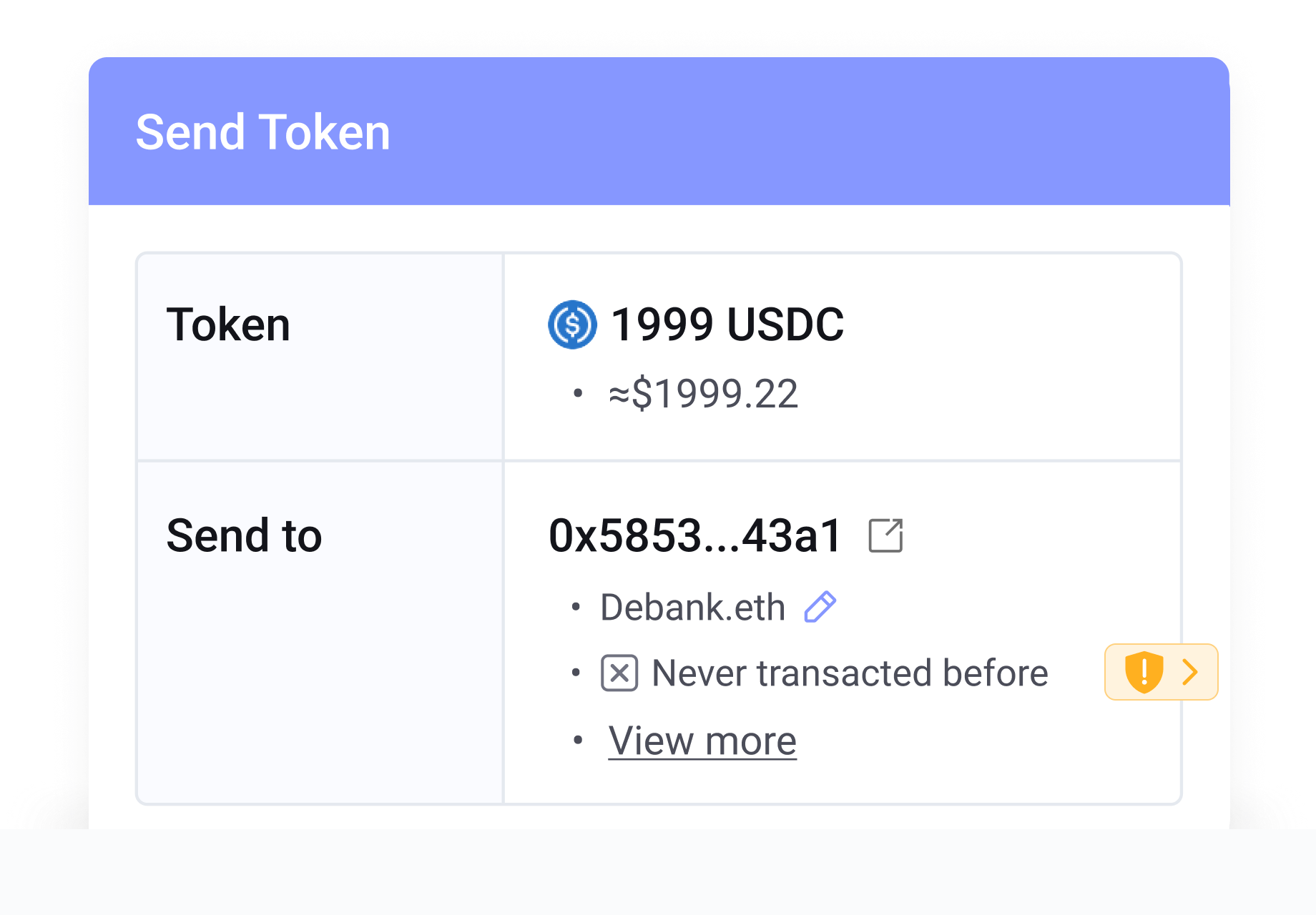
Mechanically, transaction simulation runs the intended transaction locally (or on a read-only node) against a model of the target chain state to produce concrete outputs you care about: estimated token balance deltas, revised allowances, and the fee breakdown in native gas. Instead of a generic “you are about to send X tokens,” you see “after this transaction, your wallet will show -100 USDC, +0.5 LP tokens; approval for 1,000 USDC remains.” That explicit delta is what prevents “blind signing.”
How simulation, risk scanning, and UX change decisions
Three features together alter the decision surface:
1) Transaction simulation: reveals the expected result of the call stack — not just the top-level action. It can surface surprising outcomes such as token routing through intermediate contracts, slippage causing more asset exposure than expected, or fees paid on a bridge step you forgot.
2) Pre-transaction risk scanning: checks metadata (has this contract been associated with hacks? does the approval request look unlimited or unusually broad?) and flags suspicious recipients. It does not prove innocence; it gives probabilistic warnings based on known patterns and historical signals.
3) Automatic network switching and gas top-up: reduce operational errors. If a dApp requires you to be on Optimism and you’re on Ethereum, Rabby will auto-switch, cutting a common user-error that leads to confusing “transaction failed” states. Cross-chain gas top-ups provide a practical remedy when a destination chain has zero native gas balance — a frequent pain point for users bridging assets.
Where this combination helps most
The biggest practical gains are for users who: (a) perform complex multi-step DeFi strategies involving approvals, swaps, and liquidity provision across EVM chains; (b) value a single extension or client for both day-to-day trades and custody; and (c) want stronger guardrails without moving entirely to institutional multi-sig workflows. The wallet’s support for hardware devices and multi-sig integrations like Gnosis Safe is important because simulation is a complementary control, not a replacement for key custody discipline.
Limits and trade-offs: what simulation does not solve
Transaction simulation significantly reduces a class of operational risks, but it is not a panacea. Important boundaries:
– Simulation depends on accurate state and node responses. If the node is out-of-sync or the simulation model misses on-chain oracle behavior, estimated deltas can be wrong. That’s a practical limitation rather than a conceptual failure.
– Simulations cannot foresee off-chain governance forks, token contract owner keys being used to change behavior between simulation and execution, or newly exploited contracts with zero historical signal. A zero-day contract exploit remains possible even with historical-risk scanning.
– Rabby currently lacks a built-in fiat on-ramp and in-wallet staking. That matters for users who want to buy assets directly in-app or delegate to validators without leaving the wallet. You’ll need external fiat services and staking UIs for those actions.
– Prior incidents (for example, a 2022 Rabby Swap contract exploit) show that even teams with strong response plans can experience losses. The team response — freezing the contract and compensating users — is an important governance and operational signal, but it underlines that smart contracts and integrations remain a source of residual systemic risk.
Comparative trade-offs versus alternatives
How does choosing Rabby compare to using MetaMask, Trust Wallet, or Coinbase Wallet? The main trade-offs to weigh:
– Security guardrails: Rabby’s explicit simulation and approval-revocation UI give clearer, transaction-level feedback than vanilla MetaMask. That’s the principal differentiation for power users.
– Ecosystem fit: MetaMask has the broadest third-party dApp recognition; however, Rabby’s automatic network switching and ‘Flip’ toggle to swap default wallets reduce friction when you need to test or roll back behavior between wallets.
– Institutional needs: Rabby integrates with enterprise custody solutions and multi-sig providers. If you operate a small fund or DAO, these integrations plus simulation make Rabby a candidate for a more auditable, defensible workflow — though you’ll still pair it with hardware wallets and multi-sig where possible.
Decision framework: when to download and use Rabby
Here is a short heuristic for U.S. DeFi power users deciding whether to install and make Rabby their primary wallet:
1) If you frequently interact with novel contracts and chains and want explicit pre-signature information, Rabby’s simulation and scanning move the needle strongly in favor. The cost: learning new UI elements and trusting a different extension.
2) If you need in-wallet fiat purchases or native delegation/staking, Rabby will not fully replace a solution that provides those — but it can still be a superior execution and security layer paired with third-party fiat providers.
3) If your workflow requires institutional-grade custody with multi-sig, Rabby’s integrations are helpful; still, never assume a single tool covers custody and governance. Use multi-sig and hardware vaults as primary custody, with Rabby as an access and UX layer.
To download and explore the client across browser, desktop, and mobile, see: rabby wallet.
What to watch next (signals, not promises)
Three signals will matter to users evaluating whether to increase operational exposure to wallets like Rabby:
– Broad adoption of transaction-simulation primitives by dApps and wallets. If more tools publish standardized simulation outputs, composability safety will improve because third-party dashboards can verify expected deltas before execution.
– Continued security hardening and external audits. Open-source projects with frequent audits and transparent patching histories reduce information asymmetry; watch how teams respond to new incidents and whether they adopt bounty programs or automated formal verification.
– On-ramp and staking integrations. If a wallet like Rabby adds fiat rails or native staking, it changes the substitute-cost calculus for users by reducing context switches. Right now, the lack of native fiat and staking is an explicit constraint.
FAQ
Q: What exactly does Rabby’s transaction simulation show before I sign?
A: It displays estimated token balance changes, the gas fee breakdown, and how allowances or approvals will be affected. That means you can often see the net outcome — e.g., how many tokens will be debited, what new token or LP balance you’ll receive — rather than a simple “approve” prompt.
Q: Can transaction simulation stop a smart contract exploit?
A: No. Simulation helps you avoid signing transactions with unexpected outcomes and flags contracts with bad histories, but it cannot predict zero-day vulnerabilities or off-chain manipulations. It reduces human error and some classes of social-engineering risk, but does not eliminate smart contract risk.
Q: Is Rabby suitable for institutional usage?
A: Rabby supports multi-sig and enterprise integrations (e.g., Gnosis Safe, Fireblocks). That makes it useful as a UX and signing layer in institutional stacks, but institutions should still prioritize hardware custody, multi-party approval policies, and bespoke operational controls.
Q: Will automatic network switching ever be dangerous?
A: It can be a double-edged sword. Auto-switching reduces user error but could mask the fact that you’re interacting with a less familiar chain. Always verify the network and gas costs before confirming high-value transactions; simulation helps, but user attentiveness remains essential.